The Canny alternative your coding agent can actually use.
Users post and vote on a familiar board. Behind it sits an open, queryable store with an API and CLI at the base tier, never priced per user, that your coding agent reads and writes in Cursor or Claude Code.
You're on the early-access list. We'll email you when your batch opens.
Free during early access. No spam, one launch email. Founder-built, opening the first batch to a small group.
Three quick questions
Tell us about your feedback setup.
For teams weighing Canny, Featurebase, and the rest who want the familiar board plus an open, agent-readable store and no per-user paywall.
The mess
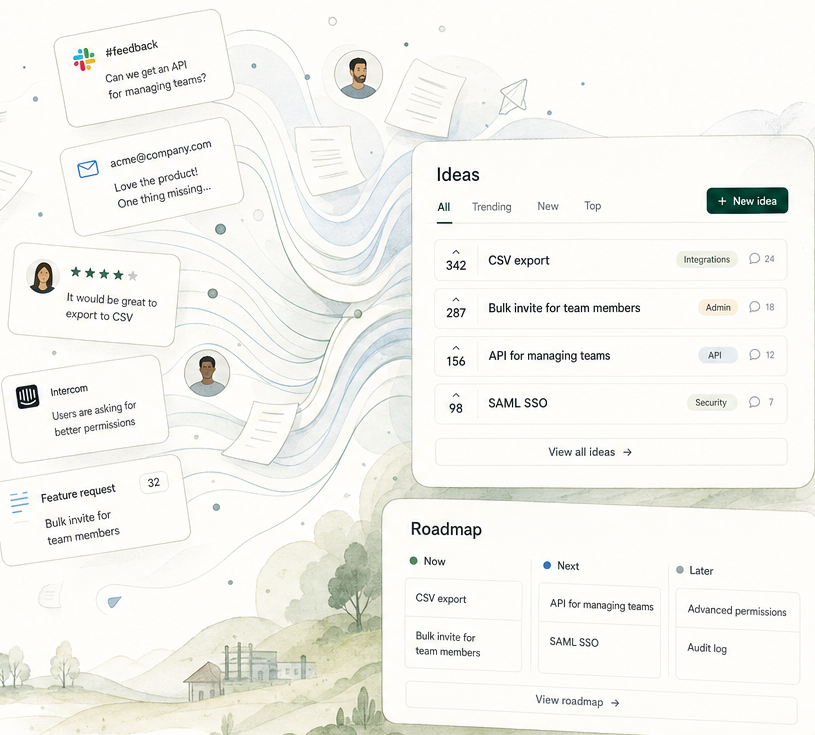
Feedback lives in five places and your agent can read none of them.
Slack threads, support chats, call notes, a spreadsheet, a board. Tria pulls it into one record that stays clean enough to act on.

The feedback loop
Ask what to build. Ship it. Tell the users.
In Cursor or Claude Code, ask what to build next. Your agent reads real feedback and answers: “23 users asked for shareable reports.” You ship the PR. Tria links it to that request, drafts the changelog in your voice, and queues the reply to those 23 users.
“Shipped shareable reports. I drafted the changelog and queued replies to the 23 users who asked.”

Collect, analyze, and act without building a feedback graveyard.
The board your users see stays simple. Behind it, every request becomes a clean record your coding agent can inspect, group, and act on.

- 01
Collect everything
Import from Canny or a CSV, your own public board, pasted notes, support threads, and customer calls into one clean store.
- 02
Find the signal
Surface duplicate requests, repeated themes, the customers affected, the source evidence, and the open questions.
- 03
Turn it into work
Your coding agent drafts merges, roadmap candidates, status updates, and follow-ups for you to review.
Questions, answered.
Is Tria live yet?
Not yet. We are onboarding the first batch of teams now. Join the waitlist and we will email you when your spot opens.
How is Tria different from Canny or Featurebase?
Same familiar board your users expect. The difference is underneath: feedback lives in an open, queryable store with an API and CLI at the base tier, not paywalled and not priced per tracked user, so your own coding agent can read and write it. You can import from Canny, and your data stays exportable.
What do my users actually see?
A clean public board where they post and vote on requests. No AI, no clutter, nothing different from the feedback tools they already know.
How does my coding agent use the feedback?
Through an open API and a CLI, the way it already uses git or gh, or as structured records it reads in Cursor or Claude Code. It groups requests by theme, drafts merges, roadmap candidates, and replies, and links them to the work you ship. It drafts; you approve before anything ships or sends.
Is the API or agent access behind a paywall?
No. Read and write access through the API and CLI is on the base tier, and it is never priced per tracked user. We charge for seats, not for letting your agent in.
What about my data?
Your feedback is yours, queryable and exportable any time. We do not sell it. See our privacy page.
Early access
Be early on the open, agent-native alternative to Canny.
Early teams get hands-on onboarding, a direct line to the founders, and a say in what we build first.
Join waitlistFree during early access. One email when we open.
